Thursday, March 7, 2013

Clipped Wings

3-7-13

The past months have been a trying exercise in patience, trust, and the struggle not to let my determination and persistence flag in the face of numerous discouraging setbacks and problems that have kept me from continuing my flight training. It has been just over two months since my last lesson.

First, it was weather. Lesson after lesson in January was cancelled due to low ceilings, bitter cold, wind or snow. Then finally a good day--at last! Sunshine and blue sky! With excitment, I met Joe at the hangar, eager to fly, and preflighted 6YE. We tugged it out, buckled in, started up and began to taxi out for another instrument flight--only to realize that the directional gyro was still spinning wildly. It sometimes does this just at first and Joe thought it might stop when it warmed up a little but he was wrong this time. It was such a beautiful day and Joe tried everything he could to get the stubborn instrument to cooperate but to no avail. Well you can't very well conduct an instrument flight without the directional gyro and so, bitter disappointment as it was, there was nothing to do but to turn around and go back, put the plane away and accept the fact that we just would not be flying today. Oh, that was so hard!

For the next few weeks, just into February, the plane was down while the instrument was being repaired. Meanwhile, I watched more beautiful days go by where I could only stare helplessly into the deep blue sky and hope it wouldn't be too much longer. Each time I saw or heard another plane fly over was a sort of torture.

At long last, the plane was fixed and I contacted Joe to set up a long-awaited flight lesson--only to have him tell me he'd just gotten another job and so would not be instructing with the EAA Flying Club or at Hartford any more! What?! I couldn't believe it! I was totally surprised--completely shocked. What next? Joe was a wonderful instructor and I'll surely miss him. 

Thus began the search for a new instructor which, up to this point, has not yet yielded much in the way of results yet. There are several possibilities but so far none of them have worked out. I'm working on this though and still cling to the hope that my next lesson and the continuation of my training are not too far off. The words of Isaiah 40:31 have become particularly meaningful to me as I wait.

"But they that wait upon the Lord shall renew their strength; they shall mount up with wings as eagles; they shall run, and not be weary; and they shall walk, and not faint."

In the midst of all these setbacks however, there is one bright spot. I passed my written exam with flying colors on Jan. 10 at Fox Valley Tech! All that studying paid off! Whew! What a relief!

Wednesday, February 6, 2013

Instrument Flying

Lesson 35
1-4-13
1.1 hours logged
43.3 hours total recorded in logbook

It was a beautiful day for flying. I met Joe at Jack Mark, pre-flighted 6YE, and we rolled her out and climbed in--or bundled in. Once again I noticed that the cockpit doesn't seem quite so roomy when both occupants are wearing at least 3 inches of extra clothing!

How many planes, or parts of planes, can you spot in this
photo?
We started up, listened to the Automatic Terminal Information Service (more commonly known as ATIS, a continuous broadcast of recorded noncontrol information containing weather observations, altimeter setting, and other airport information), and taxied out . Prior to entering the main taxiway however, we had to call ground control for permission of course. When Joe told me I was going to do it, however, I was surprised. I knew I'd have to do it eventually but wasn't exactly expecting it this soon. But Joe was already telling me what to say. He repeated it several times and I repeated it back to him. I took a deep breath, pushed mic button and spoke:
"Oshkosh Ground, Experimental six Yankee Echo is at Weeks, with Hotel, for westbound departure."

Ground control came right back with taxi instructions which Joe repeated back since I'm not sure I would've remembered everything. They cleared us to taxi via Bravo to the ramp, to taxiway Echo, across Runway 22 and hold short of runway 27. At the hold short line, we did our run-up and had to call the tower--or rather, I had to. Once again, Joe made me do it. But this transmission was quite simple. The controller cleared us for takeoff and we taxied onto the runway, paused a moment to make sure everything was set, then throttle forward, stick back slightly. The nose came up and we were airborne.

What flying "under the hood" looks like
It still surprises me how steeply the nose must be pointed up to keep the speed within the appropriate range. We flew west of town then Joe handed me a large visor with blinders on either side, otherwise known as "the hood." He took the controls while I put it on. The purpose of this device is to limit one's view to the instrument panel, simulating flight in instrument conditions.

With the visor properly adjusted, Joe gave me the controls again and let me practice holding altitude and heading in straight and level flight. Without the visual cues of outside reference, you must rely only on the indications of the instruments to tell you if you're succeeding. It's a very odd sensation at first and makes you feel a little strange. I guess you just don't quite realize how much you rely on outside references until they are gone. It's a weird feeling and to keep it to a minimum, you must avoid rapid head movements.

After flying along straight and level for a while, Joe had me make first some 90-degree turns, then a few 180's. Eyes continually scanning the instruments, this isn't too hard as long as you stay on top of things. Catch errors early and adjust gradually. A key to instrument flying, in addition to having faith in the instruments rather than trusting your bodily sensations, is to make any needed adjustments to the controls in small increments.

When he finally let me take the visor off, I found we were flying south just about parallel my house but west of highway M. We turned back toward OSH and Joe had me call the tower once again to request permission to land. It was given and we flew a righthand pattern and made a beautiful landing. Joe said it was the best I'd ever made in the RV but I'm not sure how much the credit is due me. The plane as Joe said is "a real sweetheart" when it comes to landings. I'm almost beginning to doubt it's possible to made a bad one in it!

We taxied to the fuel pump to fill the tanks before taxiing back to Weeks to put the plane away for the day. Another lesson completed, my first in the new year, my first taste of instrument flying and another lesson closer to finishing. I hope it's not too much longer.

Tuesday, February 5, 2013

Return to OSH

Lesson 34
12-11-12
1.0 hours logged
42.2 hours total recorded in logbook

Today I went flying in Oshkosh again, my second lesson there. The weather, though somewhat sketchy, was just good enough so we could go. It was snowing but sunny at the same time as we prepared to pre-flight the RV-6. Sitting in the plane waiting for the engine to warm up before taxiing out, I quickly learned two things:
6YE nestled under one engine of EAA's Ford Trimotor which
is stored in the Jack Mark hangar, along with many other
during the winter months.
1). This plane really isn't much more roomy than the Cub, especially when you're bundled in layers.
2). The heater isn't much more effective than that of the Cub. There's just fewer cracks for the cold to get in! It's still chilly though.

A takeoff on 27 to the west soon had us over the practice area. We spent much of the time focusing on the instruments and their readings through turns. It was a sort of orientation flight for the next step in my training--instrument flying. We flew south for a bit but not quite far enough to be over my house though I could see it from our position over Pickett. Sooner than I realized, it was time to head back to the airport and land.
Cockpit of the RV-6

As I flew the pattern, I couldn't help thinking how huge the airport seemed in comparison to HXF. The plane settled gently in another beautiful landing just like last time. It lands well as long as you're slow enough and that is the hard part--getting it to slow down! You have to start slowing down before you've even reached the airport!


We taxied to the self-serve fuel pump and my ears froze standing in the cold as I helped Joe pump the fuel. The wind was cutting! After only the few minutes it took to get fuel, we had to go through the whole ordeal of bundling and buckling ourselves into the plane, then call the tower for permission to taxi to the hangar. This was granted and soon we were climbing out into the cold once more to push the plane back inside. We were all glad to be out of the wind! Oh, the joys of winter flying!

Thursday, January 24, 2013

My First Solo Cross-Country!

Lesson 33
12-5-12
3.2 hours logged
41.2 hours total recorded in logbook

It looked like the perfect day for it--mostly sunny, very little wind, temperature, a comfortable 38 degrees! Nevertheless, I called down to CubAir before heading that direction just to be sure. I didn't want to chance another disappointment like last time. I was told they were planning on me flying my solo cross-country today! So this was to be the big day at last! The flight would take me to Manitowoc Airport first, then to Dodge County Airport in Juneau, and finally back to HXF if all went as planned.

Again, I made the drive anticipation rather than nervousness. After going through the mental "gearing up" for the flight several times already, only to have it come to nothing, I found that any nervousness I might have felt had long since worn off in my eagerness to do it. I knew I was ready. It's true I still felt that bit of uncertainty that naturally accompanies doing something for the first time but I'd carefully gone over every detail I could think of well before, mentally reviewing each part of the flight, step by step. I'd asked the questions I needed to, I'd written notes to myself about the things I thought I might forget, my sectional had long since been carefully marked with my course and checkpoints, my flight log was filled out as much as it could be--I was thoroughly prepared.

So it was that I arrived at CubAir eager to be on my way. However, there was still an hour's worth of preparation to be done first. Stephen was there to help me out. First, we got the winds aloft forecast and, using this information, calculated my compass heading, the time it would take to fly each leg, and fuel burn. The wind was not really much to speak of which I was perfectly all right with! Then, it was time to pre-flight. With a bit more than the usual care, I checked each detail of control surfaces, engine compartment, landing gear, etc. as I'd been taught to be certain all was in working order. Meanwhile, Stephen filled the fuel caddy and when he returned with it, I helped him by cranking the fuel in while he held the hose up to the wing tank opening. I would need this supply to replenish the fuel burned from the forward tank in the nose. Stephen made sure I'd have all I needed plus a very healthy reserve. With this important job complete, I helped push the Cub out of the hangar. I'd already stowed my various charts, notes, logbook and other papers in the cockpit. Everything was ready.

Several times throughout the course of all this preparation, Stephen asked me if I was nervous. "No, not really," I told him. He gave me bits and pieces of last minute advice on what to do, or what not to do in this or that situation. In a final word of caution, he pointed out to me a bank of greyish-looking clouds hanging over the eastern horizon. "If those clouds end up being at your level, turn around and come back," he told me. "There's nothing that says you have to make this flight today." I nodded my understanding and, ducking under the wing, climbed in, fastened my seatbelt, arranged by papers so they would be easy to reach as I needed them, and folded my sectional carefully. Stephen, who stood nearby, took a step forward to help me close and latch the trapezoid halves of the door, then turned and walked away with the words, "Have a good flight." I took a deep breath. From this point on, I would be on my own. 

Okay...first things first. I went through the start-up checklist. "Brakes set, stick back, throttle cracked, mags hot..." "Clear!" I hollered and pushed the starter. After a few reluctant turns of the prop, the engine caught began it's reassuring throb. I put on my headset and verfied that it, and the radio were turned on and working properly. Everything was set; so, returning Stephen's wave, I taxied off in the direction of 11. Prior to entering the runway, I made sure to do the pre-takeoff instrument checks, final control checks, and run-up. Everything was looking the way it was supposed to. Taxiing into position, I transmitted with more confidence than I felt, "Hartford traffic, Cub 9721Y, departing 11, Hartford." Then I pushed the throttle to full power and at 12:05 p.m. I was on my way.


Allenton and Hwy 41
I climbed to 500 feet before exiting the pattern and then--then what? A sudden feeling of bewilderment swept over me. After so many flights consisting of time after time around the pattern even though I'd left it several times with an instructor and even once by myself, to leave the comfort of it's familiarity suddenly had me feeling lost almost before I'd even begun. For a brief moment or two I wondered what to do next but even as my mind was still trying to "figure it out", I knew enough innately to at least get the nose pointed in the general direction I wanted to go and and so I set aside my momentary perplexity and did what I knew to do. With the nose of the Cub pointing generally to the northeast, I soon began to recognize landmarks by which I quickly oriented myself. There was the tall steeple of the church in the little village of St. Lawrence which I pass on my drive to the airport. There, ahead of me was highway 41 and beside it, the town of Allenton with it's distinguishing water tower. Using this as a reference, by the time I'd reached the highway, my first checkpoint, I had established myself on the proper heading, or as close to it as possible considering the rather imprecise compass with which the Cub is equipped. I had also reached my chosen altitude of 2,000 ft. and reduced the throttle for cruise.

Leaving highway 41 behind, I felt I was really entering the unknown but I stuck to my course as best I could, keeping a close eye on my sectional and the landscape below, constantly searching for landmarks. I got a little worried when Kewaskum didn't seem to be in sight after a few minutes. This was to be my second checkpoint and my course line showed that I was supposed to fly directly over the town. Where was it? A minute later, I spotted a water tower. It was right on my course and as I flew over it and the surrounding town, I was relieved to read the name "Kewaskum" printed in bold black letters on its round dome. This was a huge boost to my confidence. I had reached my second checkpoint exactly on course.

One by one the others appeared and I carefully marked down the time as I crossed each one. When they seemed to be late in showing up, I found that, as with Kewaskum, a little patience on my part was all that was required as long as I just stuck to my course and didn't allow myself to be swayed by the temptation to turn towards something, anything, that looked like it might fit the notations on my sectional. I also kept my eye on the layer of grey clouds Stephen had pointed out to me but found them to be comfortably above my altitude.
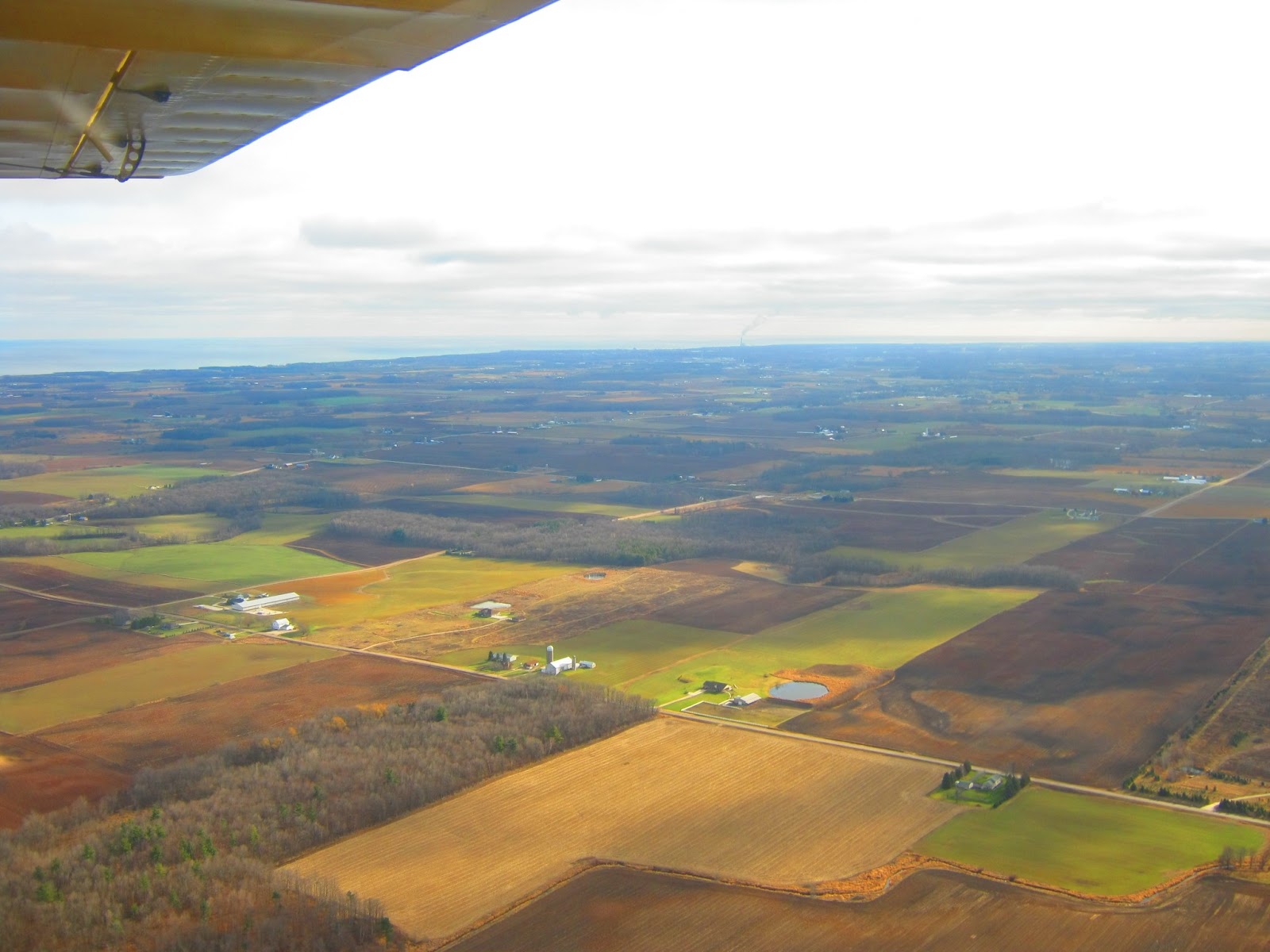
Sheboygan powerplant just visible by the wisp of steam on the horizon.


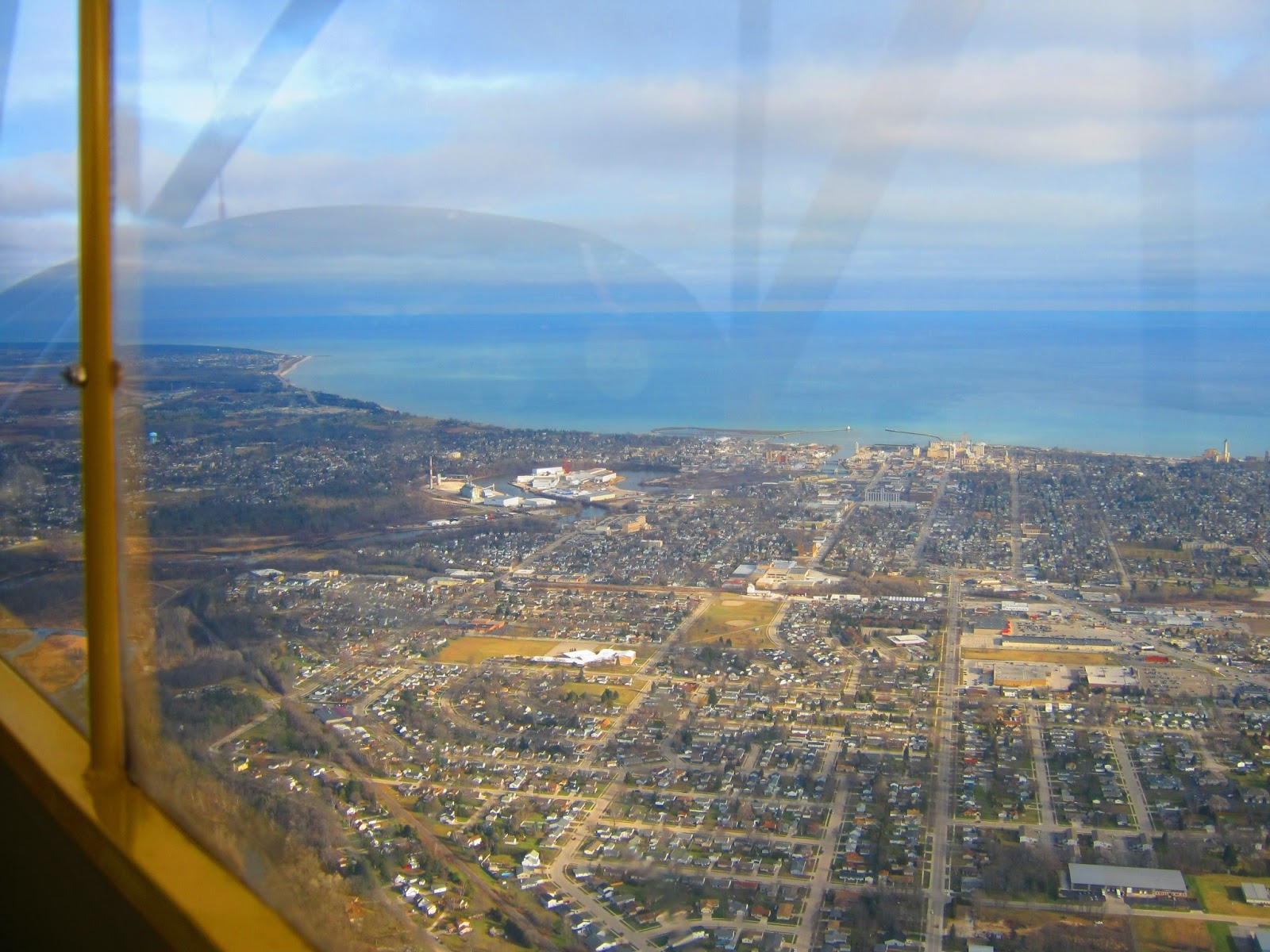
The City of Manitowoc
Now stretching all along the eastern horizon and almost blending in with the clouds, I could see Lake Michigan. And there, on it's shore, were the distant smokestacks of a powerplant near Sheboygan. Stephen and Joe had told me I would be able to see these. To the west-northwest I could see Lake Winnebago and so, by means of looking at these big landmarks then narrowing  it down to smaller and smaller ones, I was able to judge that I was indeed still exactly on course. Everything was looking beautiful! Roads and highways lined up as they were supposed to. Power lines and railroad tracks appeared just as they were shown on the sectional. 

I had switched over to the Manitowoc radio frequency and had been listening for a while to get an idea of the traffic there. Now about ten miles out, with the city already in view ahead of me, I made my initial radio call. "Manitowoc traffic, Cub 9721Y is about 10 miles to the southwest, inbound for landing, runway 070, Manitowoc."

Now I could see the airport materializing out of the haze to the north of town. I had decided to fly over once just to get an idea of how things were situated since this airport was new to me. It's amazing how confusing things can suddenly look when landing at an airport you've never seen before. For a moment I wasn't even sure how to go about entering the pattern for 70 (which a look at the windsock confirmed would be the best choice for landing) but some quick thinking straightened things out in my mind and, descending to pattern altitude, I entered midfield left downwind announcing the fact over the radio as I did so. Turns to base and final completed the pattern and, remembering to add carb heat with the usual power reductions, I found myself coming down to meet my shadow on a runway that looked positively huge! Despite it's hard surface, the Cub touched down so lightly and gently that I barely felt it and honestly wasn't even certain when the wheels actually contacted the ground. I slowed and could've stopped in only a fraction of the runway available but I kept up a little speed to reach the taxiway, turn off, and get clear of the runway as quickly as possible. 

From here, it was as simple as finding my way over to the parking area which I'd seen during my flyover and parking the plane as near I could on the T-shaped parking place. I knew I could push it in place the rest of the way so I cut the engine and in the silence that followed, I gave a happy sigh of relief at having successfully completed the first leg of my flight with a beautiful landing at a very unfamiliar airport. I switched off the radio and pulled off the headset. Opening the door, I stretched my cramped limbs and climbed out stiffly. After putting things in order in the cockpit, I pushed the plane into position. In a row of nosewheel equipped, neutral painted Cessnas and Pipers, the little yellow Cub stuck out like a dandelion in the grass and made a very pretty picture I thought.

Then I noticed a guy coming out of the airport FBO to meet me. He carried a pair of chocks and as he drew within speaking distance, he greeted me cordially and asked where I was from. I told him. He invited me to come inside and warm up for a while. Being more than a little cold, I was glad to oblige.


Not much wind
Leaving Manitowoc Airport
Inside was another guy who invited me to help myself to coffee, fruit and granola bars, relax in the sitting area, look around in the small pilot ship or otherwise make myself at home as I chose. I looked around for a while, appreciative of the warmth with which I was greeted as well as that of the temperature inside the building. After some time, I was mostly warmed up and so decided I'd better be on my way. I walked back to the Cub and one of the guys came and took the chocks. I climbed in, buckled up, closed the door making sure it was latched and, arranging my charts once again, started up and taxied out, choosing to use runway 35 this time. The winds were light and variable and seemed now to be favoring this runway. By the time I'd completed the pre-takeoff checklist, however, it was coming from a more easterly direction, directly crosswind to my chosen runway. The sagging windsock seemed to indicate that it really didn't matter much so I decided to stick with my original decision and taxied onto the runway, pausing momentarily to collect my thoughts before pushing the throttle to full power. The takeoff was no problem and with far less uncertainty, I turned to my new heading and established myself on course for Dodge County Airport, Juneau. Arrival should be around 3:00. Between now and then all I had to do was stay on course and mark my time over checkpoints. For the time, I could relax (slightly anyway) and enjoy the beauty of the landscape passing below me. Yes, even in December, there is a certain beauty in the gold of harvested fields contrasting with the grey woods and blue water.


Everything went fine for the most part. I did allow myself to stray off course once when trying to make what I saw on the sectional agree with what I could see out my window instead of just sticking to my course and waiting as I should have done but the error wasn't too serious and so I was soon able to get back where I was supposed to be. I knew I couldn't really be lost as long as I could still see Lake Winnebago on my right and Lake Michigan on my left. I could also see highway 41 stretching away to the north almost to Oshkosh. Though miles and miles away, the way the sun hit it, it shown like a ribbon of silver.
Town of Kiel
Sheboygan Marsh


Beautiful countryside
Village of St. Cloud


Hwy 41 and Quad Graphics
Airstrip next to Quad Graphics
It wasn't too long before I reached the point where my course crossed the highway just north of Lomira, near Quad Graphics and, for the next few miles, there could be absolutely no doubt about where I was. After crossing my checkpoint at Mayville however, for the first time I wasn't exactly sure of where I was. I had made my initial call to Juneau, estimating I was about 10 miles out, and was surprised to get a reply! "Aircraft inbound to Juneau, Welcome to Dodge County!" And she gave me the wind information. But now to find the place.

Hwy 41 stretches away to the south
Quarry west of Lomira
Just after takeoff at Dodge Country-Juneau Airport
Unfortunately, I again let my natural inclination to wander from my course to look for landmarks instead of letting them appear, get the better of me and it wasn't until I reached the north edge of Lake Sinissippi that I caught the error and steered back to Juneau, now approaching from a easterly direction instead of northeasterly. After another few minutes of anxious waiting, flying in that direction, things began to make sense once again as Horicon came into view, quickly followed by Juneau and the airport. Now it was a simple matter of entering and flying the pattern. A glance at the direction the smoke billowing from some stacks in the town to the south told me that my planned use of runway 80 would still be best and I entered the downwind leg, flew base, and turned final making the appropriate announcements over the radio as I did so. In accordance with my reductions of power, the runway came up to meet me and once again, I set down with only a bit of a bump. At once, the plane was trying to veer off its straight course down the runway but quick work on the rudder pedals soon overcame this. I let it roll out a few seconds then advanced the throttle evenly and smoothly and was soon airborne and climbing over the runway. Once again, I had used only a tiny portion of the available space so that by the time flew past the terminal and hangars on the east side of the airport, I was already approaching 500 feet. My dad had come over to the airport after work  to watch me fly by and although I didn't see him, he was there watching. That was special!

Lake Sinissippi
Well with the nose already pointed in almost the right direction and Lake Sinissippi already in sight, I knew this last 15-minute leg would be easy. Already the ground below us looked familiar and it seemed the Cub knew we were headed for home. It was a beautiful time of day to be flying. The light of the setting sun behind us bathed the landscape in golden light and caused the treelines surrounding fields and lining roads to cast long shadows making a very fascinating pattern which you cannot fully appreciate except from the air.


Home in sight!
Turning final for 11.
Then, casting my eyes ahead, I realized I could already see the airport though we were still miles away! I hadn't even made my first radio call announcing our approach yet! But the light of the sun brought out the white of the hangars making them gleam and as with the highway earlier, made the runway stand out quite unmistakeably. I could even see it glint off an airplane just preparing to takeoff. I listened to its pilot announce his departure and watched him takeoff then pushed the button to make my own call: "Hartford traffic, Cub 9721Y, is about five miles to the west, inbound for landing runway 11, Hartford." I could hardly keep the growing excitment out of my voice and smiled when I heard Stephen's voice over the radio come back with the words, "Congratulations, Serena! Good job!" It was the first time I'd heard his voice since leaving HXF hours ago and it warmed me all through to hear his words. He must have stayed only long enough to know I was safely on my way in for a landing because, by the time I'd circled the airport (it sure was good to see its familiar buildings and runways!) in a standard pattern, made another good landing (this time on grass--I decided to give myself a break after two landings on concrete), and taxied up to the CubAir hangar, cutting the switches as I rolled to a stop, only Steve was there. But he stood waiting until the prop had made its final turn then stepped over as I opened the door and flashing his wide grin greeted me heartily, "Welcome to Hartford International!" I grinned right back and slowly began to disentangle myself from the plane, headset cords, charts and papers.

It was only when I climbed down stiffly and tried to walk that I realized how cold I actually was. I could barely feel my feet! Steve knew I would be cold and so as soon as the plane was safely back inside the hangar, he ushered me into the office to warm up while he filled out the paperwork which kindly included even my logbook. My hand was so stiff and numb I doubt I could've done this right then. But even as I wiggled my toes and blew on my hands to restore the feeling in them, I was smiling. Nothing could erase my happiness. Another 3.2 hours logged as pilot-in-command! It was another of those lessons which I walked away from with a skip in my step and light heart and sincere gratitude to my instructors and to God who helped me reach this point--one of those which makes the more difficult ones seemed totally worth it.
9721Y safely back home in the hangar

Wednesday, January 23, 2013

Bush Flying in Wisconsin--Or as Close as You Can Get to It!

Lesson 32
11-29-12
1.0 hours logged
38.0 hours total recorded in logbook

The weather seemed perfect. Sunny skies, low winds, slightly warmer temperatures (the sun  being out helps a ton). I couldn't have asked for better conditions especially considering the time of year. So I made the drive down to HXF fully expecting to be gone until sometime well into the afternoon. Today I would finally make my first solo cross-country--at last! The delay in plans between my last flight and this had pretty much erased any feelings of nervousness about making the flight so most of what I felt now was simply anticipation--eagerness to have it done! 

Thus I arrived the airport mentally geared up and prepared to go. Joe was there waiting, ready to look the weather over with me and assist me with final flight planning as needed. The weather reports all looked good. Winds were great--a direct tailwind on my first leg but only 10 knots, nothing too tricky to land in. With the wind information, I began filling in the remainder of my flight log. It was as I was in the middle of this process that Steve (Krog) came into the office. He'd just returned from a flight with another student and told us, "You may want to reconsider that flight today." My heart sank as I heard the words. "Visibility is not very good and the wind at 500 to 1,000 feet is really howling," he informed us. What?! I thought. A look at the windsock seemed to indicate little wind and I recalled that the wind turbines had barely been turning on my drive down. As for visibility there was some haze I had noted during the drive but it didn't seem too bad.

Well that right there is a prime example of the difference only 500 feet can make. While it was true that winds at the surface were relatively low velocity, only 500 feet higher they were definitely blowing! And while the haze didn't seem so bad from the ground, at 500 feet altitude, it was much more pronounced in its effect. Although it would seem obvious, this also demonstrates the importance of checking the actual weather outside before leaving on a flight and not just relying totally on the forecasts and other weather reports! Two lessons learned already before even leaving the ground! The news was still disheartening nonetheless.

"What'd you have to come in and tell us that for?" Joe griped playfully to Steve. I smiled wryly knowing that Joe would certainly take Steve's word for it. Once again I was forced to come to grips with the bitter fact that you cannot change the weather. It's all the harder to take though, when looks are so deceiving. A look out the window and through the hangar door to the wind sock and the beautiful blue sky...oh! it was so disappointing! But I, too, had to be willing to trust my instructor's better judgment and so resigned myself to the fact that I would simply not be going. "There's only one problem," I said. "I'm down here." To have driven all that way and now...now what?


Warming the engine
Well Steve, though the bearer of the bad news, now came to the rescue with a "plan of action" as he called it. "Oooo, better watch out. This could be dangerous!" Joe kidded while Steve grinned back mischievously at him. His suggestion was that Joe take his (Steve's) next student and Steve would go up with me, take me out to a couple tiny grass strips and practice short-field takeoffs and landings with me. He's been wanting to do this with me he said. "It's not something I normally do with primary students but since you're going to be doing mission flying in and out of these little bush strips, I think this will really help you. Remember we're going to make you the best woman missionary pilot there is out there. So if that sounds okay with everyone, that's what we'll do." 

There were no objections and so while Steve fueled our bird and pre-heated the engine, I sat in the office as he told me to and struck up a conversation with the student he'd just returned with. He was an older man, probably in his 60's who had come all the way from Montana for a week of hard and fast instruction in an effort to complete his sport pilot training which he'd begun quite some time before but, because of issues with flight instructors and other problems, had let drop for six months. He came here because there's no one out there who instructs in Cubs! Wow! That sure makes me appreciate living this close to CubAir. I guess I'll never look at that two-hour-round-trip drive quite the same again!

But why come all that distance just to learn to fly in a Cub? For him, the simplicity of flying that type of plane was the draw. He is a grass farmer and in his words, "it's just like a piece of farm machinery to me. Easy to use, easy to repair." So while still only on his second day of instruction in the Cub, he, like so many others, was already finding it pure joy to fly. He was also able to sympathize with my disappointment at the cancelled solo cross-country flight. "I think mine was cancelled thrice before I finally got a day that was good enough," he recalled. Just then, Steve stuck his head in the door to let me know I could pre-flight our Cub for the day--'186--so I said goodbye to the man, thinking how good it had been to talk to a fellow student pilot who had gone through some of the same frustrations as me. It always helps to know you're not alone.

As I was pre-flighting the plane, I was approached by Joe's student for the day, another guy who also looked to be about in his 60's. This would be only his second flying lesson of any kind and he was preparing to pre-flight the other Cub with Joe's help. He watched me silently for a few seconds then asked, "Are you an experienced pilot?" The question took me rather by surprise. I had to laugh. Me? An experienced pilot? Did I look like it I wondered? I guess I just never thought of myself in that vein before and the thought struck me funny. I wondered if the man had spoken in jest but it didn't appear that this was the case. Both his voice and manner told me quite the opposite. He was quite in earnest! Still laughing a little, I told him, "I'm just another student pilot." Though I may have thirty-some hours more than him, I'm far from an expert!

As I finished the pre-flight I was thinking, here's a guy just getting started with his flight training and I've just finished talking to another who's almost ready for his checkride. I think that must be one of the most exciting parts of flight instruction--having students at all stages of the flight training process and watching them, one by one, reach their next goal whether it's to make that perfect landing, to solo, or to pass a checkride.

After I'd completed the walk-around, I met Steve in the office and he explained to me in a bit more detail exactly what we'd be doing and where we'd be going. "We'll go to two strips. The first is 1,000 feet long with trees off one end. When you first see it, you're gonna wonder how you're ever gonna land on that. It'll look about like trying to land on the deck of an aircraft carrier but by the time we've made a few landings I'll bet you'll be using only half the total length of the strip. Then we're gonna fly to another strip, longer, but with huge obstructions on both ends--trees, houses, outbuildings. There I'm gonna show you how to sideslip it in. I want you to do this so that someday when you're out flying in Alaska or Africa with your check pilot, you'll show him a beautiful sideslip into some tiny little airstrip and he'll ask, 'Have you done this before?' and you'll be able to say, 'Oh yeah, I used to do these all the time!'"

He laughed his infectious laugh and I couldn't help thinking how much I appreciate his foresight. Flight instruction ought to be so much more than just teaching what is required just so someone can get a license or pass a checkride. Steve is doing his best to be thorough with me and even now he is thinking beyond my checkride and doing his best to prepare me for my future (as he sees it) as "the best woman missionary pilot on the field." He is as committed to helping me reach my goals as I am to working towards them, and between the two of us, I think I'll do okay. I sure appreciate this about him as an instructor.

With this as my pre-flight briefing, we pushed the plane out and I climbed in. Steve followed while Joe stood by to prop the plane for us. Steve told him to pull through four blades and then judging that it "sounds right" (How can he tell when it "sounds right"?  I wondered with amazement), I turned the switch to mags hot, Steve cracked the throttle and with both of us holding the brakes, Joe swung the prop and the engine came to life.

Steve told me runway 18-36 was not an option for today's purposes even though the wind was almost straight down 36. The crosswind to runway 11-29 was 90-degrees nearly exact so we could've taken off from either end. Steve showed me how, in such a situation,with the effects of engine torque and p-factor taken into account, 11 would prove the best choice. As we taxied out, Steve made a traffic check and reported nothing in sight--"except that Lufthansa 747 up there," and he pointed up through the skylight where, high overhead, could be seen four condensation trails melting into one marking the path of a large jet. I laughed. Steve was, of course, just playing with me. There's no way he could tell at that height that the jet was a 747, much less a Lufthansa 747! "And you think I'm crazy don't you," he said, not giving up yet. When I didn't reply with anything but a grin he added, "You know, Serena, one of these days you're just gonna get so fed up with me, you're just gonna smack me--and I'd deserve every bit of it." He can be a real smart-aleck sometimes and anyone who's met him before knows it!


Beautiful countryside south of Hartford. Holy Hill in the distance.
Lined up and ready to go on the runway, I paused a second to check the windsock one more time before takeoff. I made sure to hold the stick to the right to compensate for the crosswind as we accelerated and lifted off smoothly and gracefully. We climbed to 500, levelled momentarily for the usual traffic check, then continued climbing as we departed the pattern to the south. We flew south of the airport, south of town a few miles and as we did so Steve told me, "I don't doubt you were capable of making that solo flight today but flying should always be three things: fun, safe, and challenging and with the wind and visibility what it is today I don't think the flight would have been very fun for you." This was all the explanation I needed. I knew he was right. I was still sad it hadn't worked out but this feeling was quickly disappearing as we flew along. I found myself looking forward to the challenges of short-field takeoffs and landings.

If Steve hadn't pointed out the first strip as we came up to it, I doubt I would've seen it. Surrounded by harvested cornfields on three sides and with a little farm on the other, the brown grass of it's surface was hardly enough of a distinguishing factor. A simple windsock on a pole stood nearby but it was rather worn and faded. Yes, I'm quite certain I would've flown right on by and never known it was there.


Though the quality of this picture isn't very good, you can
still just make out the first strip we visited stretching
across the middle of it. It's easier to see the farm next to it.
Now to set about landing on this aircraft-carrier-deck of a runway! It didn't look so bad as we entered the pattern around it--until I was on final. There were some trees off the approach end that, in my care to avoid them, caused me to come in rather too high and fast. We crossed the threshold, floated and floated, still burning excess speed--and lots of runway. "There's the halfway point and you're not down. Better go around," Steve told me and I didn't hesitate. Throttle forward, carb heat off. The engine throbbed back to life startling horses grazing in a pasture beneath us. I looked down and saw them scatter, running about wildly. (It gives the feeling of flying out of some remote strip perhaps out west in the middle of nowhere! In my imagination, those might have been wild horses!) I flew the pattern again and this time I forced myself closer to those trees and made sure to reduce the throttle earlier than I felt was right. Down we came, a little floating, then we had touched down with a few small bounces. When we finally braked to a stop and I turned the plane around to taxi back for another takeoff, it could be seen that there was still at least a quarter of the runway left in front of us. Whew!

At the end of the runway, set for takeoff, Steve gave me instructions for a short-field takeoff. I thought I'd already practiced these at the airport and maybe we had, but not the way we did them out here! Perhaps this is the difference between doing them for practice and doing them "for real" as Steve assured me that this was. It was indeed true that we were taking off of a very short field indeed with some very real trees not too far off the end of the runway.

"Hold the brakes while you advance the throttle to full power, then release the brakes and get right on the rudder pedals. Get the stick forward right away then pull the plane off the ground, level it, fly it in ground effect just above the runway until you've reached climb speed then pull up and away," Steve explained as he demonstrated the first one. 

We flew another pattern and I made a second landing, already better than the last, then it was my turn to try a short-field takeoff for the first time for real! Steve talked me through it and I did just fine, climbing over those trees with plenty of room to spare. Not bad! It was exciting in a good way! I made one more landing which Steve let me do entirely on my own with only a little verbal coaching. Again, it wasn't too bad. By this time, I was able to stop within the first two-thirds of the runway if not quite the first half.

We back-taxied (this runway being too short for touch-and-goes even in a Cub) and with the simple words, "Show me a good short-field takeoff," Steve let me have the controls. Hold the brakes, throttle to full power. I felt the whole airframe vibrating around me and the stick in my hand. Okay, release the brakes and go for it! It reminded me of the part on the movie "Thirty Seconds Over Tokyo" where they're practicing for takeoff on a carrier deck. Maybe there's a bit of truth in that analogy with this little strip!

After we lifted off and cleared the trees, Steve had me point the nose in a new direction. A few miles further south, he pointed out the second strip. Again, it took me a moment to spot it and when I did I thought, We're going to land on that?! Seriously? It was longer than the other one by a bit, true, but there were trees right off the runway threshold on one end and a house on the other! In fact, the west end of the runway blended quite seamlessly into the yard surrounding the house. As if that weren't enough, Steve told me there was another house nestled in those trees on what would be the approach end of the runway today and that the guy who lives there doesn't want planes flying over his house. That meant we would have to sideslip the plane in. I never understood quite what this meant until today. Instead of approaching the runway directly head on, you approach at an angle off to one side holding the stick and rudder in what is basically a forward slip (exaggerated cross-wind control set up) with enough aileron to move the airplane sideways through the air while losing altitude simultaneously so as to descend just over the treetops. As soon as you're over the runway, you neutralize the controls to straighten out and continue the landing as normal. Sound like a lot? Wait 'til you try one!

Steve did the first one just to show me how it all works, while I followed him on the controls. If felt totally foreign to be approaching the runway from the side like that and it looked like we were heading right for the trees. I was probably almost unconsciously holding my breath as we skimmed over them, straightened out, levelled, flared, and landed all in the space of a few very adrenaline-pumping seconds! "Wow!" was all I could manage once we'd safely rolled to a stop. I didn't even know an airplane could do that! 

Both coming in to land and now as we back taxied I noted a new twist in all of this. The runway was far from level. There were a couple little hills in it and a rather large slope just at the threshold. It took a lot of power to climb this. Steve took the controls once again to demonstrate what a short-field takeoff off a sloping runway is like--a "glacier takeoff" he called it. Rather than stopping at the end of the runway prior to takeoff, you begin advancing the throttle even as you're still swinging the plane around to give the plane as much momentum as possible. This, combined with the speed picked up by the downhill slope help to get the plane airborne more quickly and thus to gain enough altitude to clear the any obstacles before reaching the end of the runway.

Now it was my turn to try all of this with Steve following me on the controls. We flew a tight pattern and again approached the strip from that awkward side angle. I forced myself to reduce the power and thus, altitude, despite the trees which appeared very close. Now kick in right rudder with left aileron until the plane is over the runway, then neutralize the controls to bring the plane briefly back to straight and level before transitioning to landing configuration. It's all done in one graceful swoop and takes mere seconds but requires obvious skill and utmost concentration.

Whew! That was the first part and probably hardest part. Now, to try my hand at a glacier takeoff! Taxiing to the end of the runway, up one hill and down, then up the second bigger one at the very end, I added power to keep it from stopping, added more to swing the plane around and as it did so, and poured on the rest so as to gain the most from downhill momentum. After lift off, I held it above the runway momentarily then climbed steeply to avoid the trees turning at the same time so as not to fly directly over the house on the end. The guy to who lives there is also the one who keeps the runway up. Steve taught him to fly years ago and though he hasn't flown for quite some time, he still likes to see planes come in and out of his little strip. Honestly, he probably wouldn't have minded us flying over his house unlike the guy on the opposite end of the runway but as a matter of common courtesy and politeness, we didn't.

We flew the pattern once again and made the approach, this time from the other side of the runway. From this angle there was a little dip in the trees just before the runway. If you aim for this, the trees don't get quite so uncomfortably close. In we came again, this time holding left rudder, right stick. Over the runway, controls neutral, swoop down and land. Not bad!

We back-taxied for one more non-stop, short-field takeoff which I made smoothly and easily, then banked the plane towards home. Steve told me I'd done a good job. I in turn thanked him for the "bush flying" experience. Though he had told me before we left that if I ever felt uncomfortable with anything we were doing to let him know, I never took him up on this. There was no need to. Rather than being nervous, I found it all rather exciting. It's a whole different realm of flying experience and it may be a while before I feel the confidence to do it alone, but I never found it frightening. I'd do it again any day. I only regret that I did not get any pictures of the second airstrip.

As we flew back to the airport, entered the pattern and touched down for the final landing of the day, Steve told me, "Someday when you're out flying in the bush you're gonna think, 'Boy am I glad Steve made me do those landings!'" I don't doubt he's right about that! Back in the office after the flight, I asked him if those strips we visited have names. (They're not even shown on the sectional.) "Only the ones we give them," Steve replied. The first is called Coffey's, the second, McGrath's.

So there you have it--my first bush flying experience and I loved every minute of it! Even though I was disappointed not to get my solo cross-country in, the experience gained and lessons learned more than made up for it and I was quite satisfied with the days work.

Friday, January 18, 2013

Building More Solo Time

Lesson 31
11-26-12
0.9 hours logged
37.0 hours total recorded in logbook

Though I'd been hoping to fly my first solo cross-country today perhaps and had prepared myself for this, when I arrived at the airport Joe told me that between the cold temperatures, low ceilings and snow showers, he didn't think it would be the best day to make such a flight both for my sake and for the Cub's. He did, however, deem it a good enough day for solo pattern work. The wind velocity was low and the wind there was was practically straight down 29.

While Joe warmed the engine, using the engine heater, I preflighted the plane. Joe pushed it out of the hangar and I climbed in and closed the door. Today, for the first time, I would be doing everything from start-up to shutdown on my own. After getting everything in the cockpit situated and in order (important when you're flying solo), I mentally went through the start-up procedures in my mind as my hands performed the steps and the engine roared to life. A look at the instruments showed everything reading the way it was supposed to so I taxied out to the end of the runway. There, I went through the pre-takeoff checklist and, taxiing onto the runway, was set to go. Remembering Joe's admonition just before I'd left to make sure not to advance the throttle too abruptly because of a tendency these Continental engines have to choke and cough and sometimes even quit when the throttle is pushed forward too quickly in cold temperatures, I made sure to add the power smoothly and gently so the engine wouldn't gulp in too much cold air and was airborne in seconds. I noticed at once the improved engine performance due to the cooler temperature--the climb rate was excellent.

It seems that it takes me once around the pattern to sort of re-aquaint myself with things so on my first approach I found myself coming in way too high. Although I might have been able to get it down to the runway safely, since I didn't like the look of things, I simply decided to abandon the approach and go around. Joe had reminded me before I left that this is a perfectly viable option.


Turning downwind for 29
My next approach was much better and I made a gorgeous three pointer on the grass. Beautiful! I noticed on this flight that it actually seems almost easier to land without the extra weight of someone in the front seat. The plane is just lighter and feels easier to control. I left the carb heat in so the engine could breathe warm air as I advanced the throttle for another takeoff. Once climbing out, I could easily push it in with my foot. I made three more fairly decent landings on the grass, then decided that since I was doing fine with those, I would try a couple on the pavement. So next time around, I lined myself up with hard surface 29 and made a landing, admittedly not quite as smooth as those on the grass had been, but I was down.

After trying one more of those, I decided to try a couple crosswind landings on runway 36. Joe had told me I could try this if I felt brave. The wind was not blowing too strongly so I figured it would be a good day to try a few solo even though it was a direct crosswind. I entered a new pattern and started my approach.  Left stick, right rudder, all the way to the runway and I was down. Whew! I took off again, made one more trip around the pattern, one more crosswind landing and decided to call it a day. Those crosswind landings can still be a little more exciting than I like! I guess that just means I need to work on them more. But it had been almost an hour anyway.

So with eight new solo landings to my credit, I taxied back to the hangar, cut the engine and climbed out. I was rather stiff with the cold and back in the warm office I made my first entry in my logbook with a hand still numb but I was excited to have made another successful solo flight and to add another 0.9 hours to my solo flight time. 

Despite the gray day, there was still a gorgeous
sunset that evening. The red sky seems to indicate days
 of better weather soon to come.
Perhaps I'll be able to fly my solo cross-country soon!
Joe had disappeared but Stephen talked to me for a while about what's next after I finally get my solo cross-countries done. It really isn't that much--just a few more hours of work but I don't see myself finishing before Christmas between weather, the holidays, and people's busy schedules. As long as I finish before spring though, I'm content. I suppose I have to be. Nothing can change the weather. I only hope I can get my cross-countries done soon. It would be nice to finish in less than 60 hours too.

Wednesday, January 16, 2013

Enjoying the Last of the Warm Weather

Lesson 30
11-21-12
1.0 hours logged
36.1 hours total recorded in logbook

As has happened quite a few times now, I came not from home to flying lesson at HXF but from Milwaukee. I had just performed a concert at St. John's Cathedral and wondered if I might be too tired for flying. I guess I shouldn't have. What better way to celebrate than by going up for a flight? It was 3:30 by the time I arrived at the airport and the sun was lowering in the sky, lending beauty through its golden rays to an otherwise dull landscape. But its descent also signalled only a limited time left for flight (since the Cubs are not equipped with position lights they can only be flown from sunrise to sunset) so I wasted no time in preflighting the Cub. Everything was fine so Joe and I climbed in and taxied to 18 for takeoff. I'd been hoping to get some solo time but gusty winds and quite a bit of traffic in the pattern and around the airport precluded this.

We stayed in the pattern and managed to fit the usual eight landings in an hour. They weren't all "usual landings" though. That's not to say they were bad. Most of them were quite good in fact, but just so things didn't get too easy for me, Joe pulled the power on me a couple times and we practiced engine out landings, specifically noting the effect of wind and how it can help or hinder a dead stick landing.

Then we switched to using runway 11 to practice some deliberate crosswind landings. I can always use more practice on these. The thought of doing them at all is still a little intimidating, I find, but the only way to overcome your fears is to face them so that is what I did and all went just fine.
Meanwhile the sun sank lower and lower and its disappearance behind a low bank of clouds resting on the horizon as we flew the pattern told us that this would have to be our final landing of the day. As we touched down, I noticed that the lights bordering the runway had come on. These give a particular beauty to an airport at night, I've often thought. We taxied to a stop in front of the hangar and pushed the Cub back inside in the last of the quickly fading daylight. Joe shut the hangar door. The Cubs were all tucked in for the night and I, too, was ready to get home.

It was a wonderfully warm day for flying--probably the last of the warm weather we'll get until spring, I was thinking. It had been a year ago that very day that I'd had my very first lesson at CubAir, and I remember how cold it was then, so I made it a point to enjoy this last of the warm temperatures. Soon we'll be saying goodbye to the personal comfort of a warm cockpit for a while.
The sun sets over HXF
My first lesson at CubAir a year ago already? Wow! More than the cold, I just remember my excitement, the thrill that only low and slow flight in a Cub can give. It was wonderful! Thus began that part of my aviation journey which has become the long road toward obtaining my pilot's license. I honestly didn't expect it to take this long. There was, of course, a long period of several months between my first couple lessons and when I picked up again in the spring and another month and a half of no flying in summer and all that bad weather last month preventing me from doing much flying. I suppose if it hadn't been for these interruptions, I'd be much farther along and likely would even be done. As it is now, my hopes of being done by Christmas  have faded. It's disappointing but beyond my control. It would be easy to become discouraged but I just have to remind myself that this is a journey and I must enjoy the ride no matter how slow it sometimes seems.